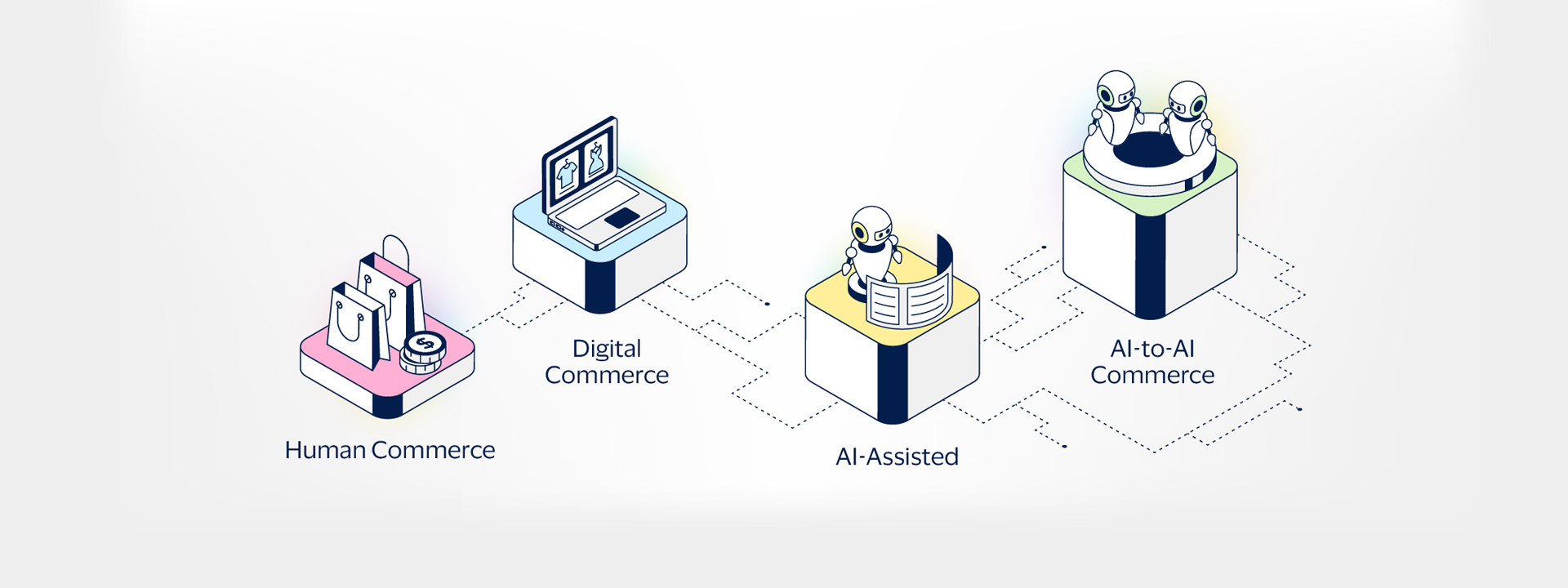
Online shopping is continuing to shape consumer behaviour, hitting AUD$82.6 billioni in Australia last year, and surpassing NZD$6 billion in New Zealand in the year 2024.ii
Over the last decade, it has been optimised for humans, with better design, faster checkouts, and more persuasive shopping experiences. As AI agents become a new kind of customer – searching, comparing and buying on behalf of people – they won’t be influenced by the same factors. They will prioritise what they can read, verify and trust.
This raises a question for businesses: when an AI agent goes shopping, who will it choose?

A new customer has arrived
Think of B2AI as a personal assistant. An AI agent that searches, compares, negotiates, and transacts on a person’s behalf, within rules set by the human customer.
Imagine Anna asks an AI agent to book the cheapest return flight from Melbourne to Hobart for under $300. She heads into a meeting, and by the time she’s out, everything is sorted. Anna remains firmly in control, giving final approval to authorise the transaction and allow the agent to complete the booking on her behalf.

What AI agents actually look for
When an AI agent is tasked with making a purchase, it's working from a set of parameters defined by its owner – budget, brand preferences, delivery requirements, sustainability criteria.
In this environment, information it can read, process, and trust is key. Traditional UX and web design won’t sway its decisions.
In the age of agentic commerce, the retailer who wins is the one whose data is cleanest, whose pricing is most transparent, and whose checkout an AI agent can navigate.
This is what it means to be B2AI ready.
In Australia and New Zealand, Visa research shows the opportunity is real.iii
- 73% of shoppers (across Australia, New Zealand and the US) are interested in using AI agents for discovery and exploration.
- Australia leads in adoption, with 44% of consumers more likely to shop with a retailer if that retailer offers an AI agent, compared with 34% in New Zealand.
- Time savings are the strongest motivator for AI agent adoption across Australia and New Zealand.
The agentic customer is coming sooner than most retailers expect and those businesses that are slow to move risk more than losing a sale. They could become less visible to an entirely new type of customer.
The trust gap and why it determines everything
Consumers in Australia and New Zealand are open to AI commerce, but not unconditionally. The issue isn’t AI, it's control.
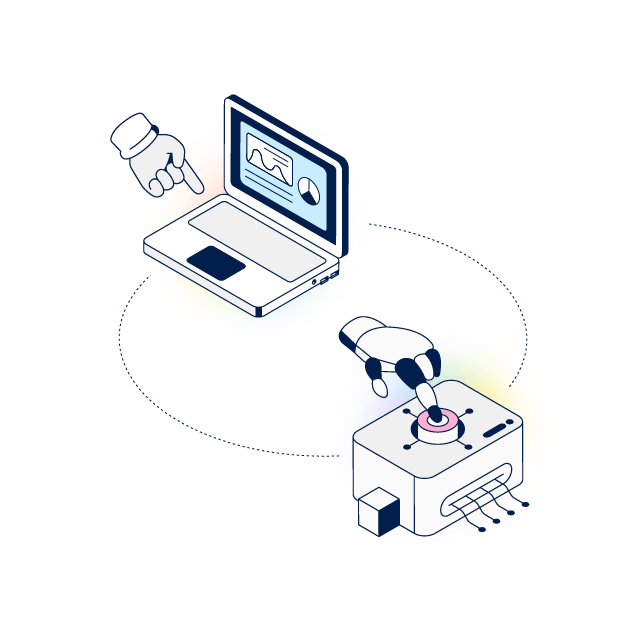
The formula that unlocks adoption is straightforward: the human sets intent, the AI executes, and the human stays in control throughout.
The vast majority of Australians (86%) want to be able to control or delete the data an agent collects. For New Zealanders, 80% said they would stop using an agent if they couldn’t control how it uses their data.iii
That insight should shape how every business thinks about deploying agentic commerce.
This is where financial institutions have a clear advantage over standalone AI platforms.
Trust, at scale, requires infrastructure. And that infrastructure already exists.
The layer of trust that allows B2AI to scale
In an AI-orientated world, it’s vital to ensure every transaction is secure and reliable. A holistic approach is key.
Visa has spent decades building exactly that infrastructure in partnership with banks and fintechs, delivering the convenience of paying with a simple tap or click, supported by a fraud prevention network that operates at scale. Tokenisation capabilities protect payment credentials at every step by replacing sensitive card details with unique digital identifiers. Merchants who have adopted Visa Token Service for their digital payments have reduced payment fraud rates by more than half (58%)iv.
For AI agents, that means no exposure of sensitive data, always up-to-date credentials, higher confidence approvals and lower risk for all participants in a transaction. Tokens weren't built for AI, but they're just what it needs.
And when a merchant is Visa-verified, an AI agent can use this information to assess if a transaction can be trusted.
Bottom Line

Human sets intent

AI executes

Human stays in control
People today shop for all kinds of reasons, and for many, browsing online or in-store is a pastime they enjoy. Building a brand and ecommerce site that connects with human customers will continue to be important, but merchants need to prepare for new types of virtual shoppers too.
B2AI isn’t about AI replacing people. It’s about representing them.
So, when an AI agent goes shopping, who it will choose increasingly depends not on what customers see but on how systems are built underneath.
The future of B2AI commerce has two participants:
- Humans who decide
- AI that executes
And the question for every business is simple: Will their agent choose you?
i. CommBank iQ, 2025, cited in Australia Post eCommerce Report, 2026. Australia Post has applied aggregation adjustments to ensure these figures reconcile with the total reported spend. https://auspost.com.au/content/dam/ecommerce-report/australia-post-ecommerce-report-2026.pdf, page 4
ii. NZ Post, 2025, NZ Post eCommerce Market Sentiments Report, https://www.nzpostbusinessiq.co.nz/sites/default/files/2025-06/Market_Sentiments_Report_2025.pdf, page 3
iii. Visa, 2026, Earning consumer trust in the age of agentic commerce, https://corporate.visa.com/content/dam/VCOM/corporate/products/documents/earning-consumer-trust-in-the-age-of-agentic-commerce.pdf, pages 5, 6, 15, 17
iv. Visa Risk Datamart, Global, FY22 Q1–Q4 Token Fraud Rate vs PAN Fraud Rate by PV for merchants with over 1,000 CNP token transactions per month per country. Merchant’s individual results may vary, https://www.visa.com.ph/about-visa/newsroom/press-releases/visa-tokens-bring-usd2-billion-uplift-to-digital-commerce-in-asia-pacific.html